.png)
1,000 signatures reached
To: The Department of Justice and Constitutional Development, Parliament of South Africa
Protect whistleblowers in Mzansi
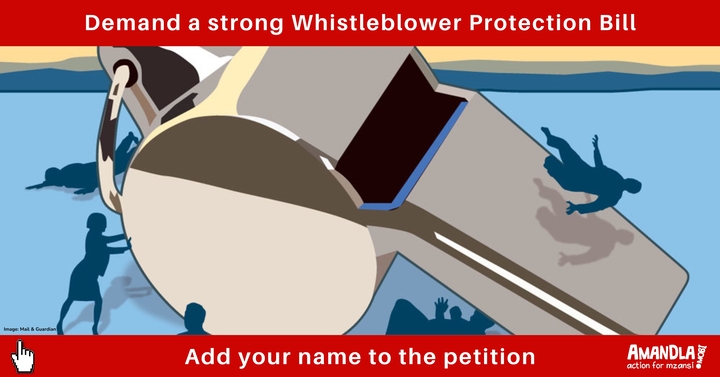
When people speak out against crime and corruption, they’re blowing the whistle to protect all of us. But in Mzansi, it’s an incredibly dangerous thing to do. That needs to change. In recent years, we have seen a spike in whistleblowers getting intimidated, threatened, and in some cases, murdered. You will know some of their names, like Babita Deokaran, who was murdered in 2021 for whistleblowing about the corruption at the Gauteng Department of Health [1]. Or Martha Rantsofu - an accountant at the Mfuleni Local municipality, who was murdered for uncovering and reporting corruption [2].
Right now, the government is discussing a bill to protect people who speak out about corruption, be it within the government, organisations, or the private sector. But experts say it’s not strong enough. Submissions are open for public comment, which means we have an opportunity to demand a stronger whistleblower bill.
We, the undersigned, call on Parliament and the Department of Justice and Constitutional Development to strengthen the draft whistleblower bill by:
- Providing a clear procedure that whistleblowers can follow for disclosure.
- Ensuring that all who provide information are immediately offered the necessary protection, especially for high-risk cases.
- For high-risk cases, the government must provide immediate protection that includes relocation assistance where needed, financial assistance for legal and other related costs, physical protection, and compensation.
- Establish an independent body that will have the power to receive and handle information, and decide what investigations and protection for high-risk whistleblowers will look like. This will help minimise interference by those implicated in the investigations.
- Make provisions for legal assistance for whistleblowers who are not eligible but at risk of financial loss and strain.
Why is this important?
According to experts, the draft bill falls short in certain areas and needs strengthening.
While the bill broadens whistleblower protection beyond the workplace to include family members and offers other forms of support, it does not provide clear steps for whistleblowers to disclose information or guarantee that they will be protected in practice [3]. This calls for strengthening the laws around protection, including clear steps for physical protection, financial assistance and compensation, and relocation assistance for high-risk cases.
The bill will also provide legal support through Legal Aid South Africa [4]. To qualify for Legal Aid assistance, one must undergo a means test to determine eligibility. Whistleblowers who do not meet the eligibility requirements for Legal Aid may face financial strain if they cover legal costs out of pocket. Another issue is that Legal Aid South Africa is already facing resource constraints, meaning that if not well-resourced, whistleblowers may not receive adequate assistance.
The government uses public submissions to measure experts’ and the public's opinions. A huge number of submissions highlighting the weaknesses in this bill will be sure to make them sit up and take notice. If enough of us flood the public submissions, we can make it clear that we do not just want gesture, but real, material protections for whistleblowers in our country.
References:
References:
[1] Silenced – why Babita Deokaran was murdered, Tevya Turok Shapiro, Daily Mverick, 21 July 2023.
[2] 10 professionals assassinated in three years, zero masterminds arrested, Reitumetse Pilane, Daily Maverick, 15 April 2026.
[3] Civil society welcomes draft whistleblower Bill, but warns that serious risks remain, Claire Rankin, Luthando Vilakazi and Roshnee Narrandes, Daily Maverick, 5 May 2026.