.png)

Following the formal submission of the petition and policy proposal on 17 March 2026 to the Portfolio Committee on Home Affairs and the Department of Home Affairs, I have now received formal acknowledgement of receipt from the Committee Secretary. This confirms that the submission has been received and entered into the Committee’s administrative processes for consideration. While no outcome has been communicated at this stage, this marks an important step in ensuring that the policy concerns raised through this petition are formally recognised within parliamentary structures. The process now moves into a consideration phase, where the Committee may review the submission as part of its oversight and policy-reflection role. Thank you to everyone who has supported and engaged with this petition. Your contributions have helped bring visibility to an issue that affects many primary caregivers, and continued awareness remains important as the process unfolds.
To: Minister of Home Affairs, Dr Leon Schreiber, Director-General of Home Affairs, Mr Livhuwani Tommy Makhode, and the Portfolio Committee on Home Affairs within the National Assembly
Review passport consent requirements for minor children of unmarried primary caregivers
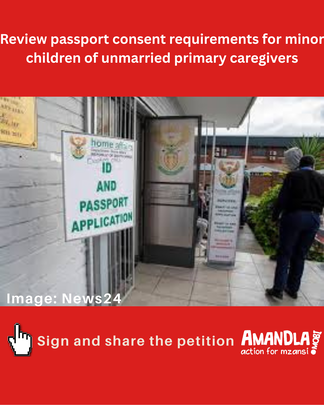
We call upon the leadership of the Department of Home Affairs to urgently initiate a formal regulatory review of the current passport consent requirements for minor children and to introduce a differentiated administrative process for unmarried primary caregivers in clearly defined circumstances.
Specifically, we request that the Department:
- Within the next three (3) months, formally acknowledge this issue and publish a notice of internal regulatory review or discussion paper examining the practical impact of the current dual-consent requirement on unmarried primary caregivers.
- Develop and publish, within a reasonable administrative timeframe thereafter, a proposed alternative to mandatory High Court applications in cases where:
- The parents were never married;
- The child bears the mother’s surname;
- The mother is the verified primary caregiver; and
- The father is not actively involved in day-to-day caregiving or resides in a different province.
- The parents were never married;
- Permit passport applications in such cases to proceed upon submission of appropriate safeguards, including a sworn affidavit confirming primary caregiving status, proof of the child’s primary residence, and evidence of reasonable notification to the father where applicable.
This petition does not call for the removal of paternal recognition from official records, nor does it seek to weaken protections against child abduction. Rather, it calls for urgent administrative reform that reduces unnecessary litigation, promotes access to economic opportunity, and upholds the best interests of the child in modern South African family contexts.
Why is this important?
This issue affects far more than one household. Across South Africa, many children are raised primarily by unmarried mothers who have never been married to the father of their child. In these families, the child may bear the mother’s surname, reside permanently with her, and depend on her for daily care, financial support, and long-term decision-making. Yet when it comes to something as fundamental as obtaining a passport, the system treats these families identically to intact or formerly married households without recognising the practical differences in caregiving realities.
The current framework, administered by the Department of Home Affairs, can unintentionally create financial and procedural barriers. Where consent cannot easily be secured, primary caregivers are often directed toward High Court litigation — a costly and time-consuming process that many South Africans simply cannot afford. For unemployed graduates, working-class mothers, and families navigating economic hardship, this becomes more than an administrative inconvenience. It can delay access to employment opportunities, educational prospects, and lawful international travel that may directly benefit the child.
This petition is not about excluding fathers or undermining child protection safeguards. It is about ensuring that regulations reflect lived realities while preserving appropriate protections against abduction or misuse. A differentiated administrative process with affidavits, proof of residence, and reasonable notification measures would maintain accountability while removing unnecessary procedural burdens. Reform in this area would demonstrate responsiveness to modern family structures and alignment with the constitutional principle that a child’s best interests are paramount.
Public support matters because regulatory reform rarely occurs without visible civic engagement. When citizens speak collectively and respectfully, it signals to decision-makers that a policy issue is not isolated, but systemic. Building public awareness and pressure increases the likelihood that the Department will prioritise review, initiate consultation, and consider structured amendments. By joining this campaign, you are not opposing safeguards. Rather, you are advocating for fairness, administrative justice, and practical reform that strengthens families rather than complicates their path forward.