.png)
-
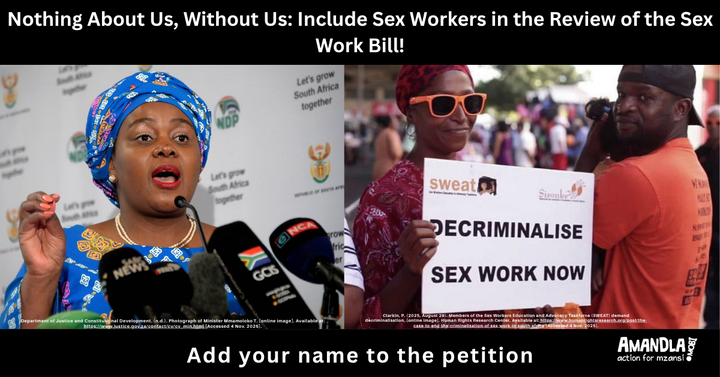.png) Nothing About Us, Without Us: Include Sex Workers in the Review of the Sex Work Bill!Sex workers in South Africa face daily violence, police harassment, and social exclusion, much of which is worsened by criminalisation. True reform cannot happen if the people most impacted are treated as an afterthought[3]. The Constitution guarantees everyone’s right to equality, dignity, and participation in decisions that affect their lives. Excluding sex workers violates these principles and undermines South Africa’s human rights commitments[4].Decriminalisation must be built with sex workers, not for them. Their voices, expertise, and lived experience are essential for creating laws that protect rather than punish[5]. Sign this petition to demand that the Department of Justice and Parliament immediately act: include sex workers and sex worker-led organisations in the review process, publish the SEIA, communicate a clear timelines, and ensure that the Bill is developed with those most affected, not for them. Because nothing about us, without us! Everyone deserves a seat at the table! References 1. Asijiki Coalition for the Decriminalisation of Sex Work, n.d. Sex Work and Human Rights Fact Sheet. Available at: https://asijiki.org.za/wp-content/uploads/Sex-work-and-human-rights_Asijiki-Fact-Sheet_Web.pdf [Accessed 4 Nov. 2025]. 2. AVAC, 2023. Decriminalisation of Sex Work Prevents HIV — South Africa Could Overturn Its Outdated Laws. Available at: https://avac.org/blog/decriminalization-of-sex-work-prevents-hiv-south-africa-could-overturn-its-outdated-laws/ [Accessed 4 Nov. 2025]. 3. Human Rights Research Centre, 2025. The Case to End the Criminalisation of Sex Work in South Africa. Available at: https://www.humanrightsresearch.org/post/the-case-to-end-the-criminalisation-of-sex-work-in-south-africa [Accessed 4 Nov. 2025]. 4. Human Rights Watch, 2019a. Why Sex Work Should Be Decriminalised in South Africa. Available at: https://www.hrw.org/sites/default/files/report_pdf/southafrica0819_web_0.pdf [Accessed 4 Nov. 2025]. 5. Human Rights Watch, 2019b. Why Sex Work Should Be Decriminalised [online]. Available at: https://www.hrw.org/news/2019/08/07/why-sex-work-should-be-decriminalized [Accessed 4 Nov. 2025]. 6. Institute of Race Relations, 2022. Submission on the Sexual Offences and Related Matters Amendment Bill. Available at: https://irr.org.za/reports/submissions-on-proposed-legislation/irr-submission-on-sexual-offences-amendment-bill-2022.pdf [Accessed 4 Nov. 2025]. 7. SECTION27 & Treatment Action Campaign, 2023. Joint Submission on Sex Work. Available at: https://section27.org.za/wp-content/uploads/2023/02/Joint-Submission-by-SECTION27-and-the-Treatment-Action-Campaign-31012023-1.pdf [Accessed 4 Nov. 2025]. 8. De Rebus, 2023. The De-criminalising of Sex Work in South Africa: A Brief Trajectory. Available at: https://www.derebus.org.za/the-decriminalising-of-sex-work-in-south-africa-a-brief-trajectory-overview-of-the-criminal-law-sexual-offences-and-related-matters-amendment-bill-of-2022/ [Accessed 4 Nov. 2025].6 of 100 SignaturesCreated by Orthalia Kunene
Nothing About Us, Without Us: Include Sex Workers in the Review of the Sex Work Bill!Sex workers in South Africa face daily violence, police harassment, and social exclusion, much of which is worsened by criminalisation. True reform cannot happen if the people most impacted are treated as an afterthought[3]. The Constitution guarantees everyone’s right to equality, dignity, and participation in decisions that affect their lives. Excluding sex workers violates these principles and undermines South Africa’s human rights commitments[4].Decriminalisation must be built with sex workers, not for them. Their voices, expertise, and lived experience are essential for creating laws that protect rather than punish[5]. Sign this petition to demand that the Department of Justice and Parliament immediately act: include sex workers and sex worker-led organisations in the review process, publish the SEIA, communicate a clear timelines, and ensure that the Bill is developed with those most affected, not for them. Because nothing about us, without us! Everyone deserves a seat at the table! References 1. Asijiki Coalition for the Decriminalisation of Sex Work, n.d. Sex Work and Human Rights Fact Sheet. Available at: https://asijiki.org.za/wp-content/uploads/Sex-work-and-human-rights_Asijiki-Fact-Sheet_Web.pdf [Accessed 4 Nov. 2025]. 2. AVAC, 2023. Decriminalisation of Sex Work Prevents HIV — South Africa Could Overturn Its Outdated Laws. Available at: https://avac.org/blog/decriminalization-of-sex-work-prevents-hiv-south-africa-could-overturn-its-outdated-laws/ [Accessed 4 Nov. 2025]. 3. Human Rights Research Centre, 2025. The Case to End the Criminalisation of Sex Work in South Africa. Available at: https://www.humanrightsresearch.org/post/the-case-to-end-the-criminalisation-of-sex-work-in-south-africa [Accessed 4 Nov. 2025]. 4. Human Rights Watch, 2019a. Why Sex Work Should Be Decriminalised in South Africa. Available at: https://www.hrw.org/sites/default/files/report_pdf/southafrica0819_web_0.pdf [Accessed 4 Nov. 2025]. 5. Human Rights Watch, 2019b. Why Sex Work Should Be Decriminalised [online]. Available at: https://www.hrw.org/news/2019/08/07/why-sex-work-should-be-decriminalized [Accessed 4 Nov. 2025]. 6. Institute of Race Relations, 2022. Submission on the Sexual Offences and Related Matters Amendment Bill. Available at: https://irr.org.za/reports/submissions-on-proposed-legislation/irr-submission-on-sexual-offences-amendment-bill-2022.pdf [Accessed 4 Nov. 2025]. 7. SECTION27 & Treatment Action Campaign, 2023. Joint Submission on Sex Work. Available at: https://section27.org.za/wp-content/uploads/2023/02/Joint-Submission-by-SECTION27-and-the-Treatment-Action-Campaign-31012023-1.pdf [Accessed 4 Nov. 2025]. 8. De Rebus, 2023. The De-criminalising of Sex Work in South Africa: A Brief Trajectory. Available at: https://www.derebus.org.za/the-decriminalising-of-sex-work-in-south-africa-a-brief-trajectory-overview-of-the-criminal-law-sexual-offences-and-related-matters-amendment-bill-of-2022/ [Accessed 4 Nov. 2025].6 of 100 SignaturesCreated by Orthalia Kunene -
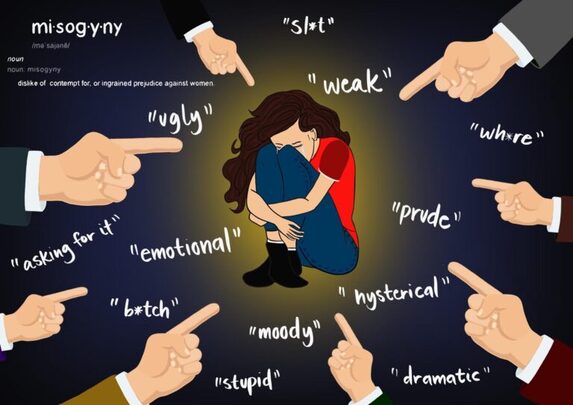 Hold Podcast Sponsors Accountable – Demand GBV Awareness Content Now!MacG’s show has a massive youth following. When harmful views go unchallenged, they normalize abuse. Your brand’s silence, or continued sponsorship without action, sends the wrong message. But your voice can help reshape culture and create safer conversations • This campaign isn’t about censorship – it’s about accountability and care. GBV is not a joke. Silence is not neutral. And brands can no longer pretend not to see the harm done in their name. By calling on the podcast to prioritize monthly content on GBV, consent, and gender justice, Nike, Nestle , Standard bank and many more can: • Align sponsorship with their own brand mission and values, • Help shift how young men understand masculinity and accountability, • Support content that protects,not harms,women and families, • Show the public it listens and leads with integrity. GBV thrives in media spaces where harm is minimized or mocked. Why Sign? •Because GBV, misogyny is not entertainment. •Because brands must fund solutions-not silence. •Because youth deserve content that educates, not harms. By signing this petition, you’re demanding that popular culture becomes part of the solution -not the problem. You’re calling on powerful companies to use their influence responsibly, and you’re standing with survivors who deserve platforms that respect their stories and struggles. #SponsorsActNow #ChillersforChange Let’s call them in -not out - to be part of the change South Africa needs. Reference list: Podcastandchillnetwork.com. (2018). Podcast and Chill Network – Africa’s #1 Podcast Network. [online] Available at: https://www.podcastandchillnetwork.com/. Mphande, J. (2025). ‘Enough is enough’ — Women For Change slams MacG’s remarks about Minnie Dlamini. [online] TimesLIVE. Available at: https://www.timeslive.co.za/amp/tshisa-live/tshisa-live/2025-05-02-enough-is-enough--women-for-change-slams-macgs-remarks-about-minnie-dlamini/ [Accessed 3 Jul. 2025]. Ngwako Malatji (2025). Minnie Dlamini takes MacG to Equality Court and demands R2.5m. [online] Sunday World. Available at: https://sundayworld.co.za/celebrity-news/minnie-dlamini-takes-macg-to-equality-court-and-demands-r2-5m/?fbclid=IwZXh0bgNhZW0CMTEAAR6oU_hKTlLXoydxMY5xcWF6cvDrPQyliWgSLzMwsJMD3bngN1l9wPKZDumNJg_aem_sul7p0xg1SBgC2MpHwVf1A [Accessed 4 Aug. 2025]. Natasha (2021). Amanda Du Pont takes legal action against MacG – KAYA 959. [online] KAYA 959. Available at: https://www.kaya959.co.za/amanda-du-pont-takes-legal-action-against-macg/ [Accessed 3 Jul. 2025]. Ngwako Malatji (2024). Nkosazana Daughter sues MacG for R13m. [online] Sunday World. Available at: https://sundayworld.co.za/celebrity-news/nkosazana-daughter-sues-macg-for-r13m/ [Accessed 3 Jul. 2025]. TSHISALIVE (2025). ‘It is a damaging reinforcement of gender-based disrespect’- Moja Love condemns MacG’s derogatory language. [online] TimesLIVE. Available at: https://www.timeslive.co.za/amp/tshisa-live/tshisa-live/2025-04-29-it-is-a-damaging-reinforcement-of-gender-based-disrespect-moja-love-condemns-macgs-derogatory-language/ [Accessed 3 Jul. 2025]. Deputy Minister Mmapaseka Steve Letsike on utterances by Macgyver Mukwevho toward Minnie Dlamini on Podcast and Chill which constitute online gender-based violence | South African Government. [online] Available at: https://www.gov.za/news/media-statements/deputy-minister-mmapaseka-steve-letsike-utterances-macgyver-mukwevho-toward. Graye Morkel (2022). MacG apologies to Ari Lennox for problematic questioning: ‘I’m not a malicious person’. [online] News24. Available at: https://www.news24.com/life/arts-and-entertainment/celebrities/macg-apologises-to-ari-lennox-for-problematic-questioning-im-not-a-malicious-person-20220202-2 [Accessed 3 Jul. 2025]. The Mail & Guardian. Available at: https://mg.co.za/friday/2022-02-08-macg-is-leading-the-wave-of-misogynistic-podcasts/128 of 200 SignaturesCreated by Mpho Masilo
 -
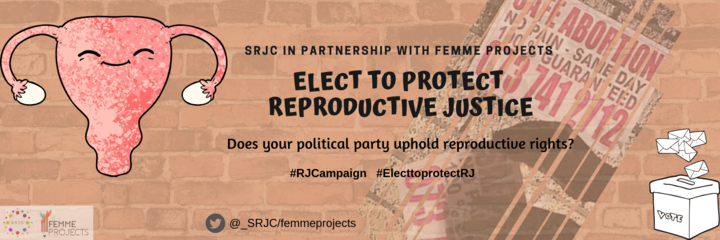 Tell the 3 major political parties to support increasing sexual and reproductive health budgetYOUR CALL TO REPRODUCTIVE JUSTICE: WE ARE WATCHING AND LISTENING Reproductive Justice [1] is defined by three principles: The right to have a child; the right not to have a child; the right to parent children in safe and healthy environments. In 1997 South Africa enacted a globally renowned law on abortion. The Choice on Termination of Pregnancy Act (CTOPA) aimed to address the imbalances of the past where 429 black women died each year from lack of access to these basic health services [2]. The political act of passing this legislation was historical in laying the framework for Reproductive Justice in South Africa. Having an act such as CTOPA in place meant that women and pregnant people would be free to make their own decisions about their bodies and their futures. 22 years later, many people still struggle to access these basic services. But with national elections coming up, we have a chance now to ensure the 5 major political parties commit to lobbying for an increase in the sexual and reproductive health services budget. There is limited information on how people can access abortion services, decreases in the amount of contraceptives available and currently only 7% of healthcare facilities provide abortion services [3]. Because of this, many pregnant people are either forced to turn to unsafe and illegal abortion practices or suffer the physical, emotional and mental harm that comes with bearing an unwanted pregnancy. Leading up to elections, political parties will be running election campaigns focused on winning votes. If they want our votes, they will need to prove to us that they care about the lives of all people seeking access to Sexual & Reproductive Health services. We have a chance now to pressure the 5 major political parties into using their power as members of Parliament to address these issues by ensuring the budget for sexual and reproductive health services is increased. This money will be used to create sexual reproductive justices and access to these services for ALL. This will ensure greater access to public information on safe abortion procedures, fully stocked healthcare facilities with affordable and free contraceptives and more healthcare facilities nationwide providing safe, legal abortions. Sign and join our campaign to ensure sexual reproductive justice for all. If enough of us come together and flood the email inboxes of the 3 major political party leaders, they will have no choice but to support increasing the sexual and reproductive health budget. We have written an email that you can send to one, or all, of the political parties. Here is the email and each political party's email address: ANC- [email protected] EFF- [email protected] DA- [email protected] "Dear Political Party Leader (Mmusi Maimane, President Cyril Ramaphosa and Julius Malema) I am joining other South Africans in calling on you provide leadership on reproductive justice. Reproductive Justice is defined by three principles: The right to have a child; the right not to have a child; the right to parent children in safe and healthy environments. We need you to support an increase in the sexual and reproductive health budget for 2020 and use your power as a member of parliament and political party leader to lobby for an increase before voting day on 8 May. Currently there are decreases in the amount of contraceptives available, there is limited information on how people can access abortion services and currently only 7% of healthcare facilities provide abortion services. Because of this, many pregnant people are either forced to turn to unsafe abortion practices or suffer the physical, emotional and mental harm that comes with bearing an unsupported pregnancy. A budget increase will ensure that there is sexual reproductive justice and access to these services for ALL. We need health managers to lead and to not obstruct access to reproductive justice services. The money should be spent on ensuring that public healthcare facilities are always fully stocked with contraceptives, health professionals are trained in the provision of sexual and reproductive health services and greater access to information on safe abortion procedures and increased delivery of public services of abortion provision. It is time you took sexual and reproductive health seriously. If you want my vote, you must prove to me that you truly care about the people most affected by the lack of sexual and reproductive health services. The Choice on Termination of Pregnancy Act (CTOPA) aimed to address the imbalances of the past where 429 black women died each year from lack of access to these basic health services. 25 years have passed and to get our vote we want to hear your political commitment to real implementation. I trust you will hear our voices." [1] https://www.ucpress.edu/book/9780520288201/reproductive-justice [2] https://www.ajol.info/index.php/samj/article/view/157185 [3] https://amnesty.org.za/research/barriers-to-safe-and-legal-abortion-in-south-africa771 of 800 Signatures
 -
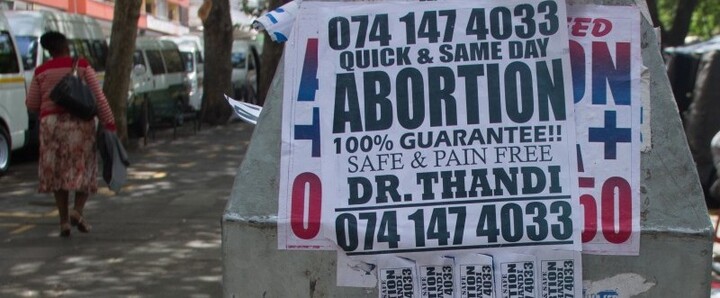
 Increasing access to safe abortions in South AfricaThe right to sexual and reproductive health (SRH) is an essential component of the right to life, the right to health, the right to education, and the right to equality and non-discrimination. Many women, young women, adolescent girls, and gender non-conforming people in South Africa are vulnerable to ill-health due to several economic and social barriers that prevent them from accessing timely and life-saving SRH services, including safe abortion and contraception. Better access to these services can prevent unsupported pregnancies and reduce unsafe abortions. When a woman is denied unencumbered access to these services, her agency and the right to make decisions about her body are limited. More than two decades have passed since the progressive Choice on Termination of Pregnancy Act (CTOPA), 1996, liberalised abortion in South Africa. However, women in South Africa continue to face barriers in accessing safe abortion services. This is due to severe stigma, refusal by healthcare providers to provide services due to their religious or moral beliefs, lack of information on the legally safeguarded rights under the CTOPA, and poor infrastructure and limited availability of safe abortion services. Due to these barriers, women and adolescent girls often resort to illegal and unsafe abortion services, which put their health and lives at risk. Unchecked advertising of ‘quick and pain free abortions’ by illegal providers perpetuates the stigma and misinformation about abortion among the population. According to a 2009 study, two illegal abortion procedures took place in South Africa for every safe legal procedure. Globally, unsafe abortion is one of the top five causes of maternal mortality, along with post-partum haemorrhage, sepsis, complications from delivery, and hypertensive disorder. In our country, many women die every year, or sustain injuries and disabilities due to unsafe abortions. For example, the 2014 Saving Mothers report, covering the period from 2011 to 2013, reveals that pregnancy-related sepsis accounted for 9.5% of maternal deaths during the said period.332 of 400 SignaturesCreated by My Body My Choice Campaign
 -
 We demand that the Department of Health make safe, free and legal abortions easily accessible!In a country faced with myriad socio-economic and structural inequalities, the right to safe, free and legal abortions is more pressing than ever. Providing access to abortion is an integral part of affording women reproductive rights and allowing them to self-determine in the face of institutionalised patriarchy. Even though abortion is legal In South Africa, as a consequence of the 'Choice on Termination of Pregnancy, 1996' this right has not been realised on the ground. According to a recent survey conducted by the 'Bheksisa Mail and Guardian Centre for Health Journalism' only 7% of the public health centres that are supposed to offer safe, free and legal abortions do so. This means that predominantly black low income women who do not have access to private health care are forced to turn to illegal abortions that are facilitated by unqualified personnel. As a result many women have reported abuse, violation and faced severe medical complications due what is colloquially known as 'backstreet abortion'. Access to abortion is extremely limited, largely due to public sentiment around abortion and an unwillingness by Government to take a firm stance on the matter and give women the right to reproductive health care they deserve. A browse through the Department of Healths's website reveals that they have information around contraception and maternity but have conveniently left out any information on abortion, what to do in the event that you want to abort or where to access a safe, free and legal abortion. Women deserve access to safe, free and legal abortion. If the Department does not commit to providing this service women will continue to be consigned to illegal abortions. They will continue to face the financial, emotional and psychological costs as well as the physical dangers associated with such abortions.56 of 100 SignaturesCreated by Sihle Motsa
 -
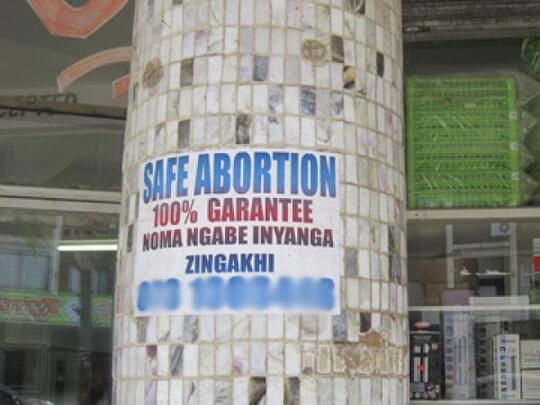 Tell the government to provide adequate information on free safe, legal abortion.In 2017 Akhona Matyeni* a matric learner from rural Umthatha, lost her life to an illegal abortion. Akhona bled to death after taking what she knew to be abortion pills, purchased for R200 from an unknown man who's phone number she had found on a poster on the streets of Umthatha. Akhona did not know that she could access a safe, legal abortion for free at a government hospital or clinic she was just desperate to ensure that nothing came between her and obtaining an education. According to the World Health Organization up to 13% of deaths among pregnant women can be attributed to unsafe abortions. Despite the fact that abortion is legal in South Africa, it is estimated that between 52% and 58% of the estimated 260 000 abortions that take place in the country every year are illegal [1]. By South African law a legal abortion can only be performed by a midwife, a registered nurse trained for the procedure, a general practitioner or a gynecologist. Many South African women and girls remain unaware of the law and the services they are entitled to. A 2005 study published in the International Journal of Gynecology & Obstetrics reveals that, in a sample of 50 South African women who had terminated pregnancies illegally/outside of designated facilities. Over 50% admitted they had done so because they "did not know the law". A further 15% said they knew their rights but they did not know where to access safe, legal abortions [2]. Access to safe abortions saves women's lives everyday. A lack of information shouldn't stand in the way of that. In South Africa poor provision of adequate information remains one of the main barriers for women who seek safe, legal abortions. As things stand it is much easier for women to access information on unsafe, illegal abortions than it is to access information on the free safe, legal abortions that our government is constitutionally obligated to provide. In 2017 Amnesty International reported that less than 7% of South Africa's 3 880 public health facilities perform termination of pregnancy. This is a figure that is far less than the 505 medical facilities that the Department of Health claims to have designated to perform termination of pregnancy across South Africa [3]. This indicates that beyond the issue of the lack of available information on safe, legal abortion facilities, there is the issue of the Department of Health itself not having accurate information on the functionality of its own facilities. An investigation into the functionality of existing facilities is imperative for us to ascertain exactly how many facilities are available and what their capacity is. A national online abortion database will ensure that every woman has direct access to information on where and how they can access a free safe, legal abortion. These interventions will save lives by drastically decreasing the number of illegal abortions taking place in our country and putting an end to the desperation that forces women to undergo unsafe, illegal abortions. We call on the public to take a stand and put pressure on our government to make these important interventions in order to save the lives of women who are turning to unsafe, illegal abortions everyday because of a lack of information. We call on you to stand with us as we demand reproductive justice for all! *Not her real name SOURCES [1] SAnews. (2018). SA's illegal abortion rate alarmingly high. [online] Available at: https://www.sanews.gov.za/south-africa/sas-illegal-abortion-rate-alarmingly-high [Accessed 6 Sep. 2018]. [2] Tshangela, L. (2018). Only 40% of public clinics provide abortions: Study - [online] SABC News - Breaking news, special reports, world, business, sport coverage of all South African current events. Africa's news leader. Available at: http://www.sabcnews.com/sabcnews/only-40-of-public-clinics-provide-abortions-study/ [Accessed 5 Sep. 2018]. [3] Dyk, J. (2018). When there was no list of free abortion clinics, we made our own. Here's how.. [online] Bhekisisa. Available at: https://bhekisisa.org/article/2017-11-10-00-mind-the-gap-only-5-of-health-facilities-offer-abortions-heres-how-to-find-them [Accessed 6 Sep. 2018].521 of 600 SignaturesCreated by Noxolo Mfocwa
 -
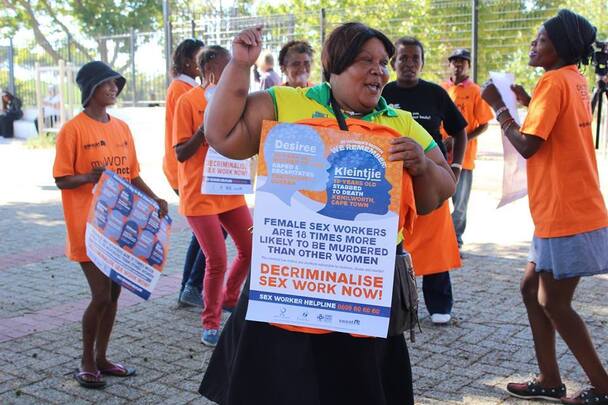 Decriminalise sex work now! Don’t let this moment passSex work is work, and right now sex workers are calling for solidarity to keep them safe by supporting the call for the full decriminalisation of adult sex work. Some in Parliament support this call and if enough of us make public submissions before the 26th February 2018, we could change the lives of sex workers. Like many other people, Nosipho uses her profession to support herself and her family, to further her studies, to save up for her future and to gain financial freedom and security [1]. But because sex work is criminalised in Mzansi, she and many others, face unsafe working conditions where they face corrupt police who want bribes or rape sex workers in exchange for not being arrested. https://www.youtube.com/embed/dg4l3X9rJHw?ecver=1 This video explains the 4 possible legal models for sex work and why South African sex workers want the full decriminalisation of sex work. Despite the overwhelming evidence showing the ongoing harm caused by criminalisation, the much anticipated sex work report by the South African Law Reform Commission (SALRC) recommends that sex work remains a criminal offence [2]. Now, for the first time in decades, there's a real chance for change. Sex workers and women’s rights groups, like SWEAT and Sisonke, have loudly condemned the report. Parliament's Multi-Party Women's Caucus noted the flaws of the report [3] and the chairperson of the Caucus stressing that the full decriminalisation of sex work is the only model that respects the rights of sex workers [4]. In just a few days, the Women’s Caucus could help determine what the future looks like for people like Nosipho. If we don’t speak out against this horrendous report sex workers may be sent back into danger. There’s only a few days left to make submissions responding to the report. Make sure to send yours through by the 26th February 2018. [1], I am a sex worker: criminalising my work puts me in danger, Nosipho Vidima for GroundUp News, June 14, 2017. [2] Parliament's women's caucus to host sex work summit, Jeanette Chabalala for News24. Feb 9, 2018. [3] Sex work report on prostitution rejected, Nicola Daniels for Independent News. May 30, 2017. [4] Multi-Party Women's Caucus disappointed about law reform commission report on adult prostitution, Ms Masefele Story Morutoa. June 1, 2017.1,001 of 2,000 SignaturesCreated by Amandla.mobi Member
 -
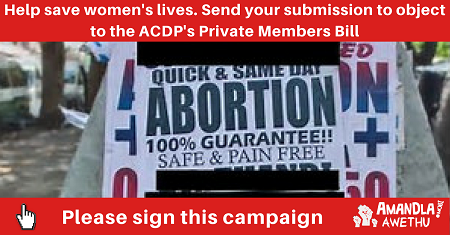 Protect women's right to chooseIn 1996, South Africa passed the (Choice on Termination Of Pregnancy Act) CTOPA to rectify the discrimination mainly suffered by black women who were unable to access abortions permitted under the Apartheid government. This resulted in an improvement in maternal deaths. Yet, twenty years later, we face problems of implementation that mean black women still die from septic abortion in SA, due to inaccessible abortion services which are stigmatized. Already, people living in different areas of South Africa have access to significantly different sexual and reproductive health services, including safe and legal abortion. Many women and girls, especially those in the poorest and most marginalised communities, are struggling to access safe abortion services, with risk to their health and lives. Instead of this proposal by ACDP, we should be directing our energy towards enhancing access, and women’s lives and health. The ACDP attempts to undermine the Choice on Termination of Pregnancy Act, and further place the lives of women, and especially poor, black women at extreme risk. This is not the first time that these issues have been raised and rejected by parliament and in our courts. We must strongly object to the Private Members Bill as proposed by the ACDP. It will have devastating effects on the lives of Black women and does not serve their interests.1,728 of 2,000 SignaturesCreated by amandla mobi member
-
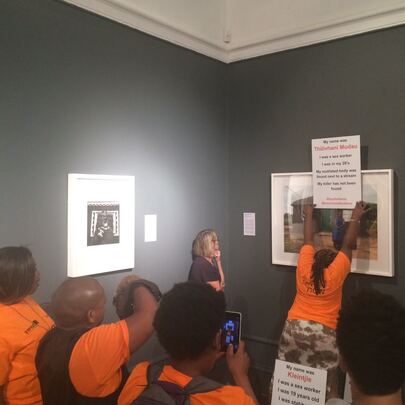 The national art gallery must respect women's livesThe art exhibition Our Lady, currently on show at the Iziko South African National Gallery in Cape Town (and intended to be shown until June 2017) was conceived, according to the gallery, to “interrupt the typical traditional moral attitudes and male dominated stereotypes that surrounds imagery of the female form”. It contained works from the gallery’s public collection and also from the private collection of The New Church Museum. However, as soon as the exhibition opened it was met with outrage. Despite three (white) women having co-curated Our Lady, it is impossible to overlook the fact that 75% of the artists on show are men (the majority of which represent women through the staid conventional lens of patriarchy and are dead white men). South Africa has no shortage of artists who critically reflect on gender in their practice. Instead, the perspectives of women, trans and non-binary artists are heinously under-represented. Of the 27 artists on show, a mere seven are women. Considerably more shocking is the fact that only three black women were represented. Given the history and present of our country, we cannot accept how disastrously short the exhibition falls, particularly in terms of creating space for artistic statements from a wider and richer range of identities that reflects the lived reality of South Africa. Furthermore, many are outraged by the curators’ decision to include the work of Zwelethu Mthethwa, who is currently being tried for the violent murder of Nokuphila Kumalo. Though he will remain innocent until proven guilty, the worth and memory of Ms Kumalo are brutally undermined by the curators’ decision to showcase a work by her alleged murderer. Adding insult, the chosen work by Mthethwa is a portrait of a black woman, who the artist chooses to treat as anonymous. The inclusion of a photograph of an unnamed black woman by Mthethwa reiterates a dominant tendency in our culture; that is, the propensity to view the most precarious in our society – including black sex workers such as Ms Kumalo – as faceless, nameless and disposable nonentities. It tacitly participates in the broader erasure of the voices of black women from our national narrative – and in our national gallery at that. The impassive attitude that this exhibition expresses towards Ms Kumalo (as well as towards those who loved her and continue to mourn her), mirrors the tragically low esteem in which black women have been – and continue to be – held in South Africa today. For all of these reasons, we stand in solidarity with SWEAT – the Sex Worker Education and Advocacy Taskforce – who have strongly condemned the gallery for its decision to include Mthethwa’s artwork. As Ishtar Lakhani of SWEAT has said, “The irony of promoting the work of a man accused of murdering a woman as part of an exhibition aimed at empowering women, is not wasted on us.” Just ahead of a public meeting about these issues The New Church Museum withdrew all of its work from the show, without offering an explanation. We believe that the public has a right to understand why a private collection has elected to silently withdraw a series of loaned works that had been committed to an exhibition in a national institution until June 2017. Public institutions should not be playgrounds for private interests. Many strong voices resonated during the intense public meeting that was hosted at the gallery on 15 December 2016. In addition to public statements made by representatives of the gallery and the New Church Museum, an open letter that was signed by all of the (living) women artists represented on Our Lady was read aloud. This collective letter demanded that all works made by its signatories be immediately withdrawn from Our Lady, as a gesture of protest against the exhibition. We were heartened by the hasty response of the National Gallery, in the form of a media statement that acknowledges that it is crucial for public institutions to remain flexible and responsive to their constituencies. The statement articulates the National Gallery’s commitment to continuing the important conversation around Our Lady, and its sincere intention to reconfigure the exhibition in the early days of January 2017. We embrace this positive momentum and continue to believe that it is possible to radically transform Our Lady to address the rampant violence that is directed against women and others who are marginalised in our culture can be compellingly communicated. However, the gallery has not clearly indicated in the exhibition space why there are so many white walls missing work and why there has been a public outcry around the show’s curation and the inclusion of work by Mthethwa. A powerful debate languishes at the skirts of Our Lady. Due to the current state of the exhibition, this debate remains inaccessible to most museum visitors. As the National Gallery decides on the curatorial steps that it will take in order to render the ongoing debate accessible to the broader public, we ask the institution to make bold decisions that will allow the voices of the protesting artists and activists to resonate accessibly and meaningfully in the public space that the exhibition occupies. We view the Iziko South African National Gallery as an ally and a partner, but also as an institution that is charged with the weighty responsibility of attending to and redressing the radical social inequity that continues to characterise South African society. In memory of Nokuphila Kumalo, for women artists, and for all women who have been and continue to be nonchalantly erased from taking a rightful seat at the table, we ask the National Gallery to move swiftly to radically reconfigure Our Lady so as to bring the ongoing debate that it has unleashed to voice.217 of 300 SignaturesCreated by In Memory of Nokuphila Kumalo In Memory of Nokuphila Kumalo
 -
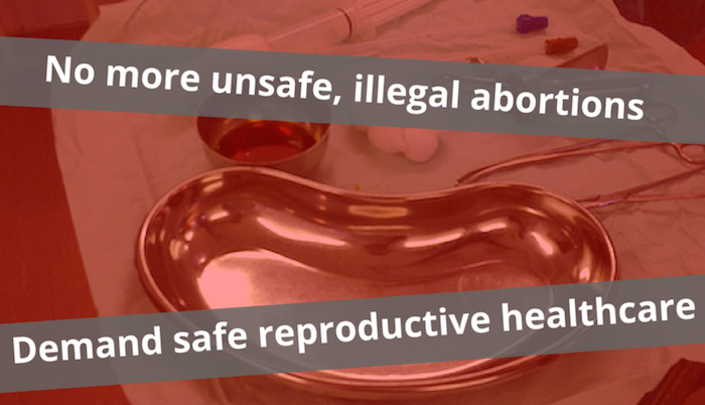 Reproductive justice nowYoung people were encouraged to register for the upcoming elections, but Noziziwe Buthelezi* won’t be voting in these elections or ever. She died last week after after a failed, unsafe abortion. While abortion is legal in South Africa, women like Noziziwe* are forced to risk their lives by using unsafe, illegal options. The posters advertising these fill our streets, yet most public institutions have no information about the safe, free alternatives available to women. If enough of us come together, we can demand that the National Department of Health (NDOH) upholds women’s right to access quality, affordable and acceptable sexual and reproductive healthcare services, including abortion. *Not her real name569 of 600 SignaturesCreated by The Sexual & Reproductive Justice Coalition
Cookies help us improve and optimise this site. Read more